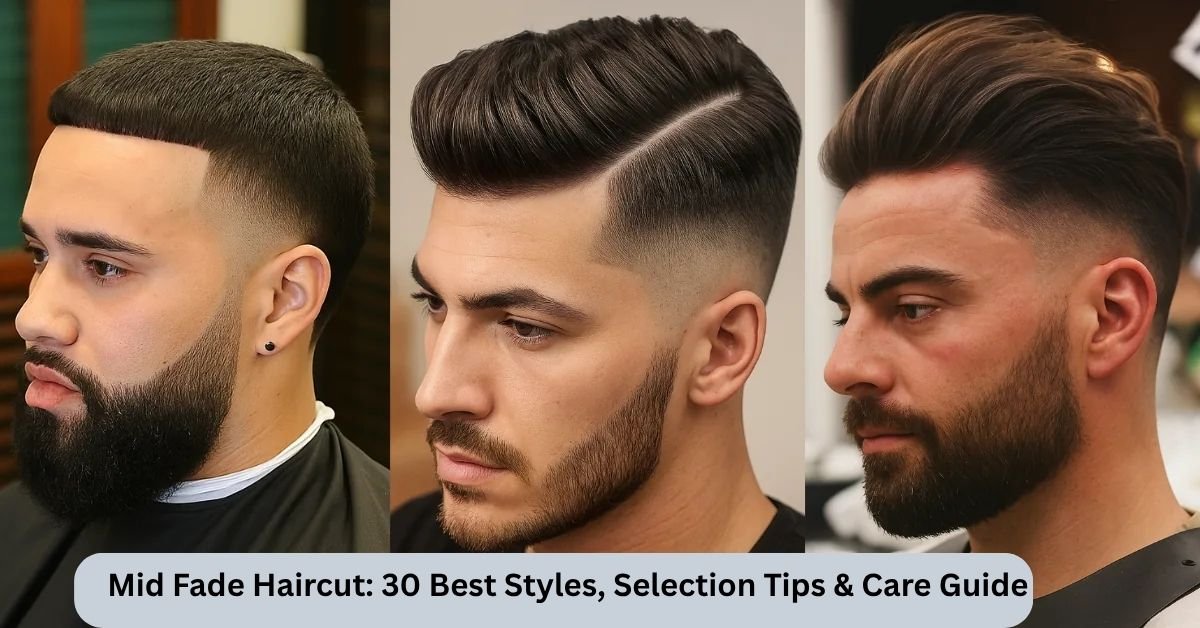
Mid Fade Haircut 30 Best Styles, Selection Tips & Care Guide
Walk into any barbershop haircut today and ask for something sharp but not too bold. Chances are, the barber reaches for clippers and starts at your temples. That’s the mid fade in action. It’s the most requested cut among popular men’s hairstyles, and for good reason. This guide covers every major mid fade haircut style, how to pick the right one for your face and hair type, and how to keep it looking fresh.
What Is a Mid Fade Haircut?
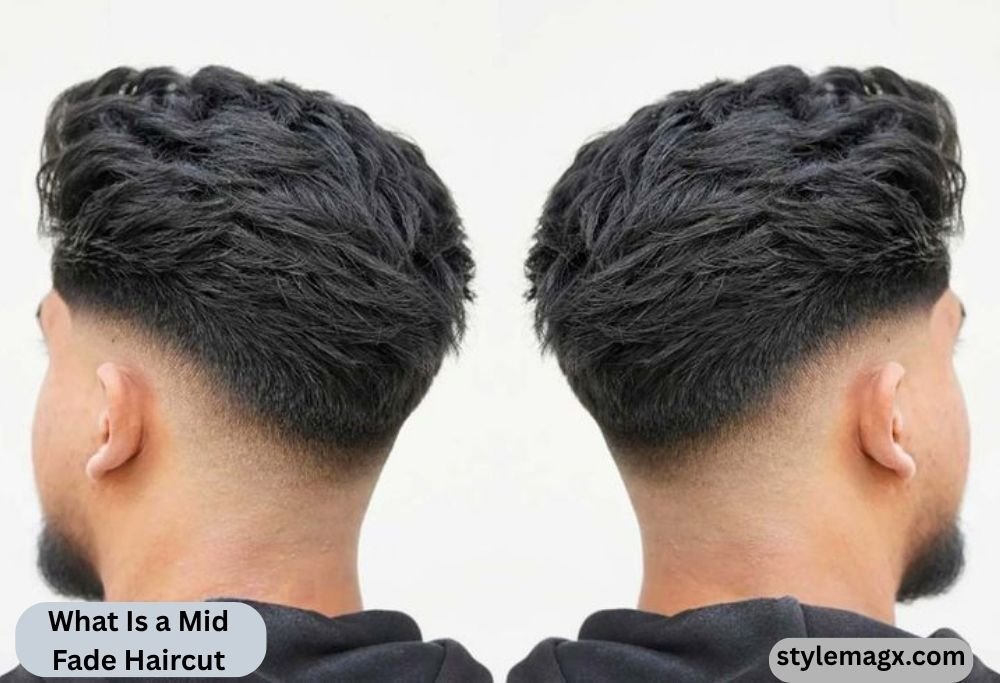
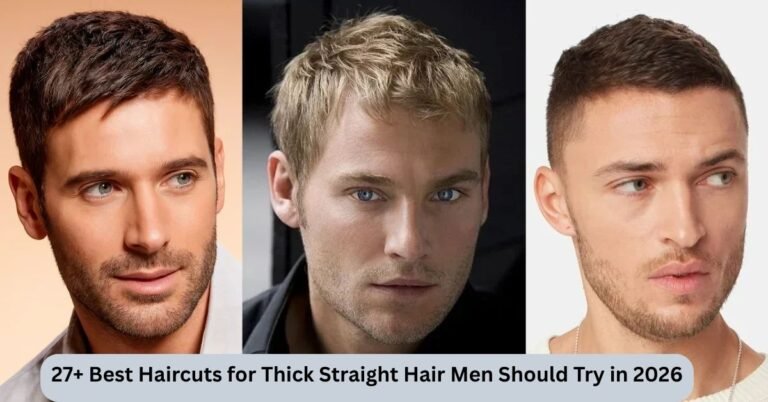
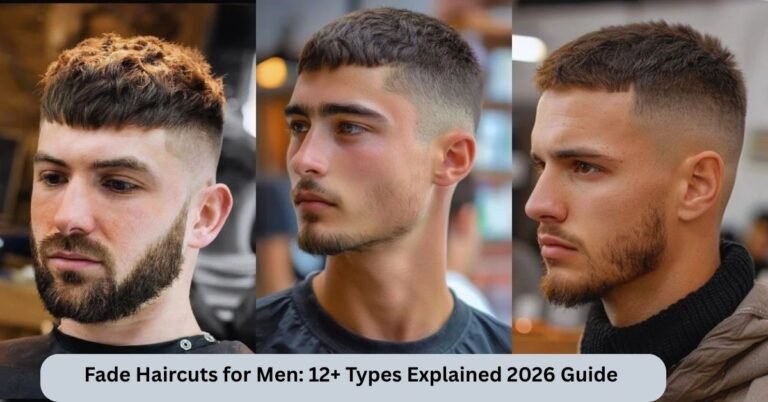
A mid fade haircut is exactly what it sounds like. The fade starts around the temples, roughly the middle of the ear, then the hair gradually blends into the skin or shorter length toward the neckline. It sits right between the subtle low fade and the bolder high fade. That middle position is why it works so well. It gives you a clean and sharp look without going too dramatic, and it suits almost every face shape out there.
This isn’t a new trend either. The medium fade haircut has roots in classic barbering, but it’s become a modern men’s hairstyle because it’s flexible. You can pair it with a textured top, keep things simple with short sides, or go bold with longer hair on top. Barbers often call it a midfade or mid fade hair cut, and honestly, both terms mean the same thing. Whatever you call it, the goal stays the same: blended sides, a natural hair transition, and a finish that looks intentional from every angle.
Mid Fade Haircut Styles to Try
There isn’t just one mid fade hairstyle. There are dozens of ways to wear it, and that’s the beauty of this cut. Some variations focus on how close the clipper fade gets to the skin. Others focus on what you do with the top. Either way, you get a low maintenance haircut that still looks polished every single day.
Below, you’ll find thirty different mid fade haircut styles, broken down by technique, texture, and top style. Some work better for thick hair, others suit curly hair, and a few are built specifically for men who want a clean-cut appearance with almost no styling effort.
Classic Mid Fade
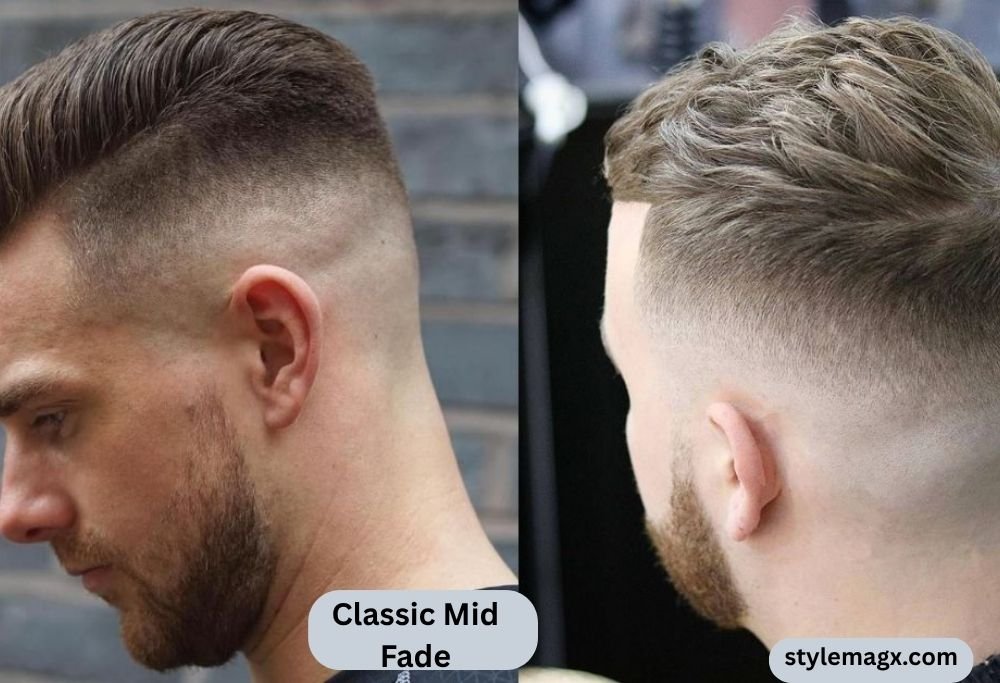
This is the classic fade in its purest form. Hair blends from a longer length on top down to short sides, with the fade beginning right at the temple. It’s straight and even all the way around the head. Barbers love this one because it works with almost any hair type and any outfit, whether you’re heading to the office or going out on a Friday night. Ask for a number one or two at the base, and you’ve got a cut that fits every setting without trying too hard.
Mid Skin Fade
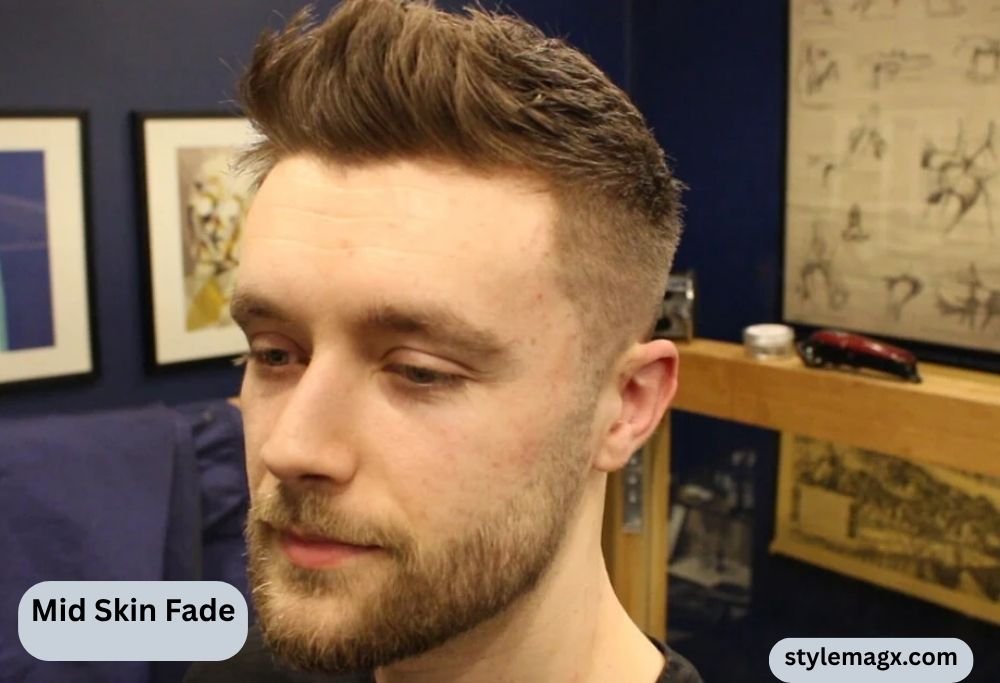
Want more contrast? The mid skin fade, sometimes called a mid bald fade, takes the sides down to bare skin instead of leaving a guard length. It’s the sharpest version of this cut, and it shows off a skin fade finish at the base with a straight razor for extra precision. Keep in mind, this style suits thick hair best. If your hair is thin or fine, bare skin at temple height can look too exposed, so a taper might serve you better.
Mid Taper Fade
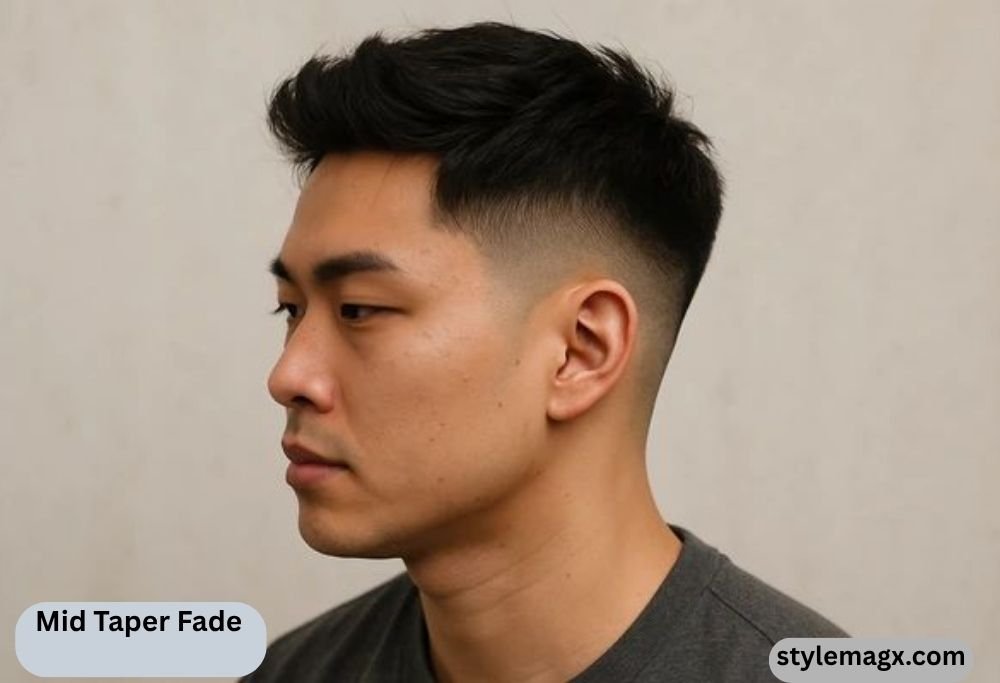
The mid taper fade never quite reaches the skin. There’s always a little hair left at the base, usually a number one or one and a half guard. That means as your hair grows out, there’s no harsh line to deal with. It just blends back in naturally. This makes it a favorite for men with fine or thin hair, plus anyone working in a more conservative environment who still wants a bit of an edge.
Mid Drop Fade
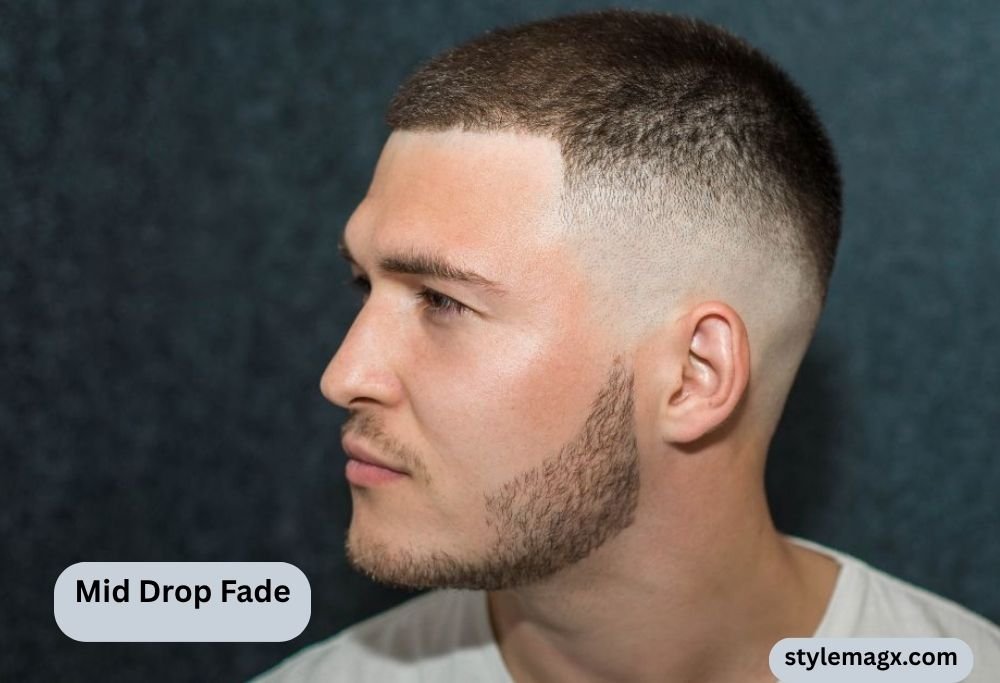
From the front, a mid drop fade looks like any other mid fade. But check the back, and you’ll notice the fade line curves downward behind the ear instead of staying straight. It adds shape and visual interest without pushing the cut into bolder territory. This one pairs especially well with curly or wavy hair, since the curve follows the head’s natural shape rather than fighting against it.
Mid Burst Fade
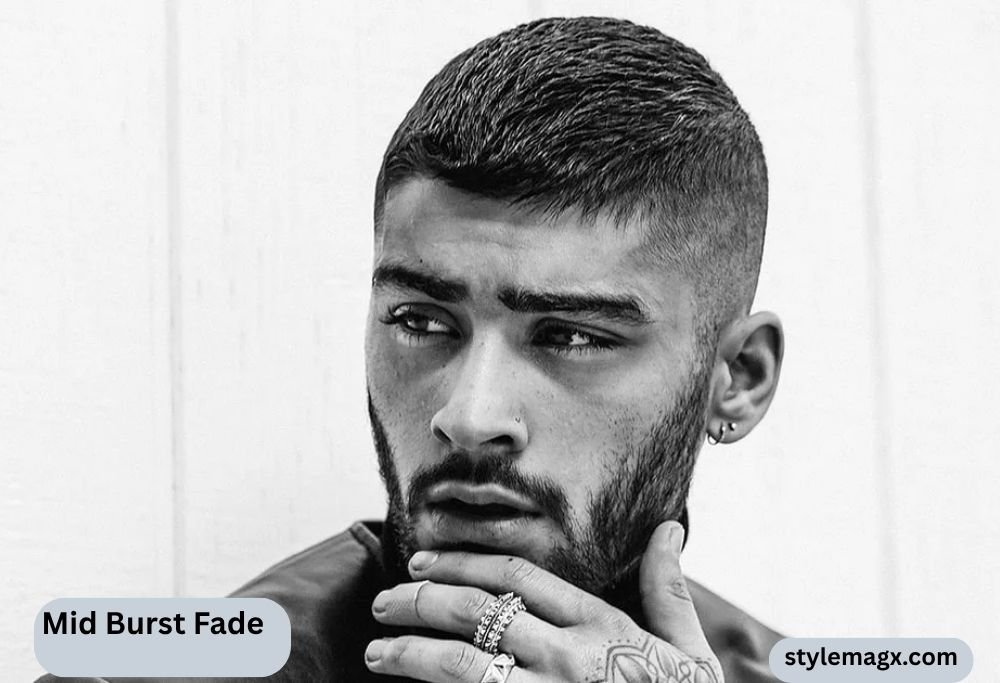
Here’s a style built for movement. The mid burst fade arcs around the ear in a semi-circle rather than running in a straight line. The back stays longer, which makes this cut ideal for mohawks, faux hawks, or natural curl patterns on top. If you’ve got curly or coily hair and want something that frames rather than flattens, this variation deserves a look.
Mid Temple Fade
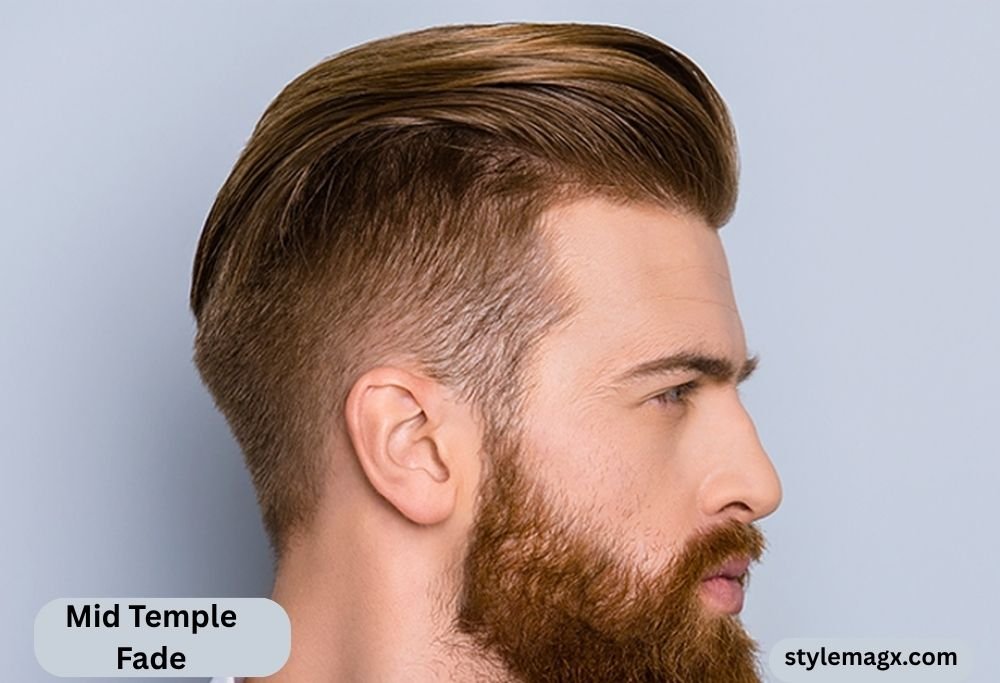
Sometimes you just want sharpness up front without touching the whole head. That’s what the mid temple fade delivers. It focuses the blend around the temples and hairline, keeping things crisp there while leaving more length toward the back. It’s a common choice among Black men rocking short cuts or textured afros, since it defines the front without demanding a full fade all the way around.
Mid Fade Undercut
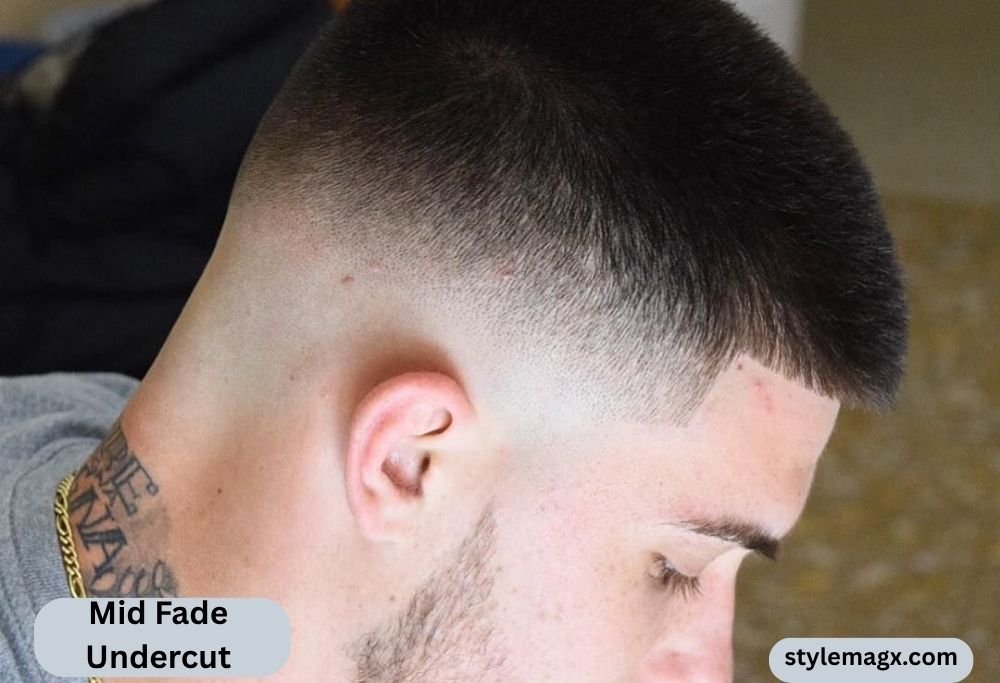
Pair a disconnected or blended undercut with mid fade sides, and you get serious contrast. The top stays noticeably longer than the sides, creating a bold, structured silhouette. This works particularly well if you want your top style, whether it’s slicked back or pushed forward, to really stand out against the tight sides underneath.
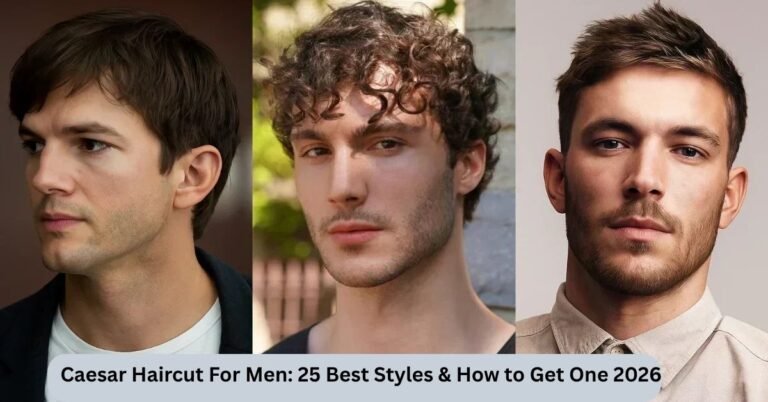
Mid Fade Caesar Cut
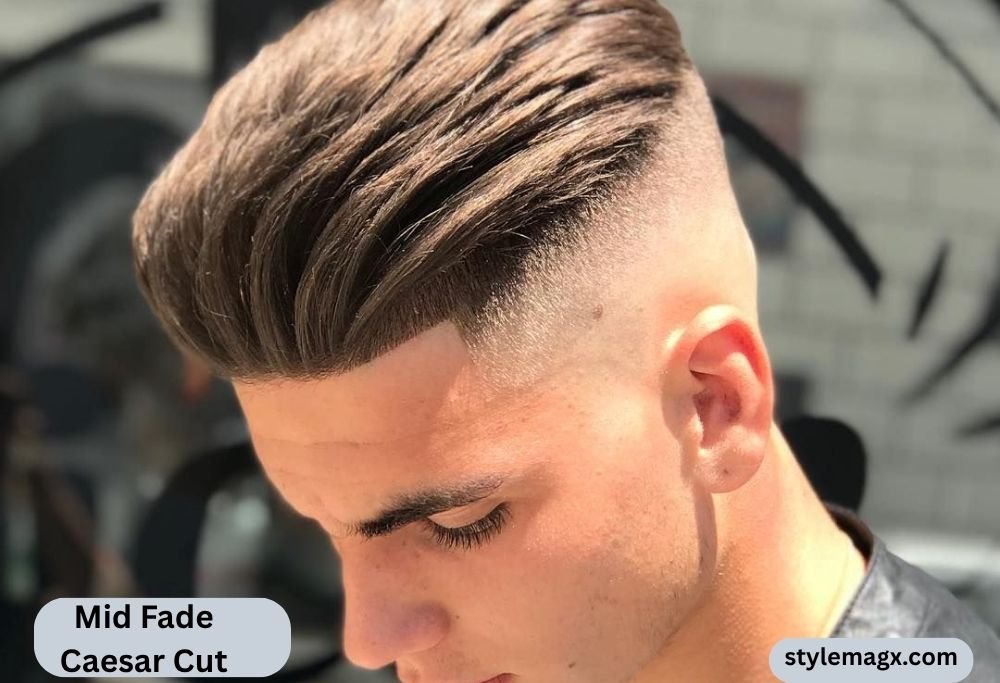
Short on top, straight fringe across the forehead, and mid fade sides. That’s the Caesar cut formula, and it’s stayed popular for decades because it’s effortless. There’s barely any styling involved. Just wash, maybe run a bit of product through it, and go. It’s a genuinely low maintenance haircut for guys who don’t want to spend time in front of a mirror every morning.
Mid Fade Pompadour
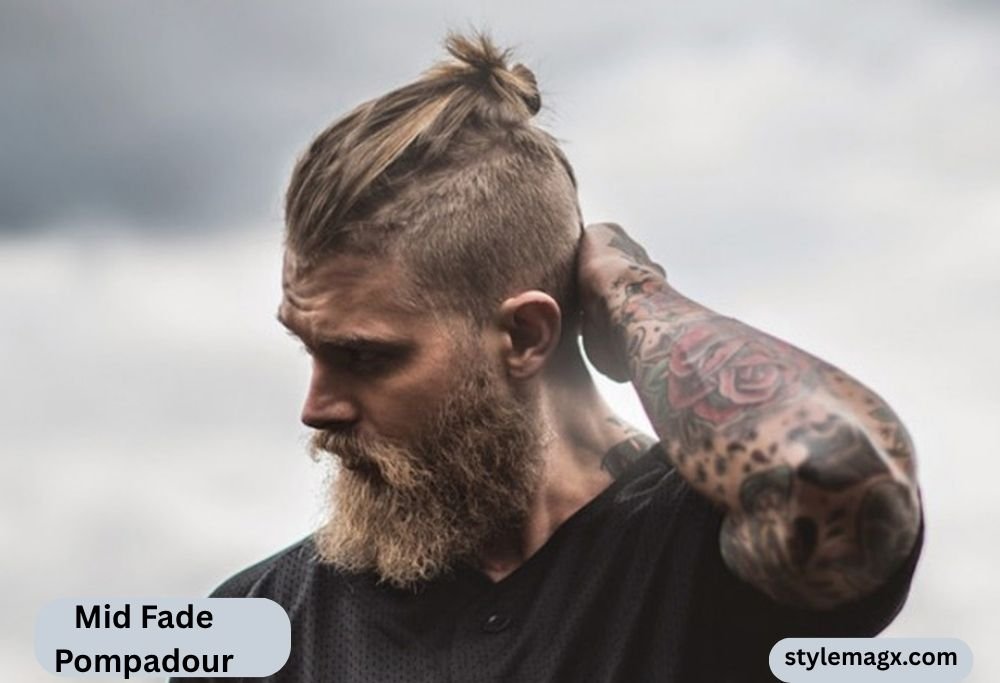
Volume meets sharpness here. The mid fade pompadour sweeps hair back and up on top while keeping the sides tightly faded from the temple. The higher starting point of the mid fade creates stronger contrast than you’d get with a low fade version, but it’s still manageable for daily wear. You’ll need thicker hair on top to pull off the volume this style calls for.
Mid Fade Quiff
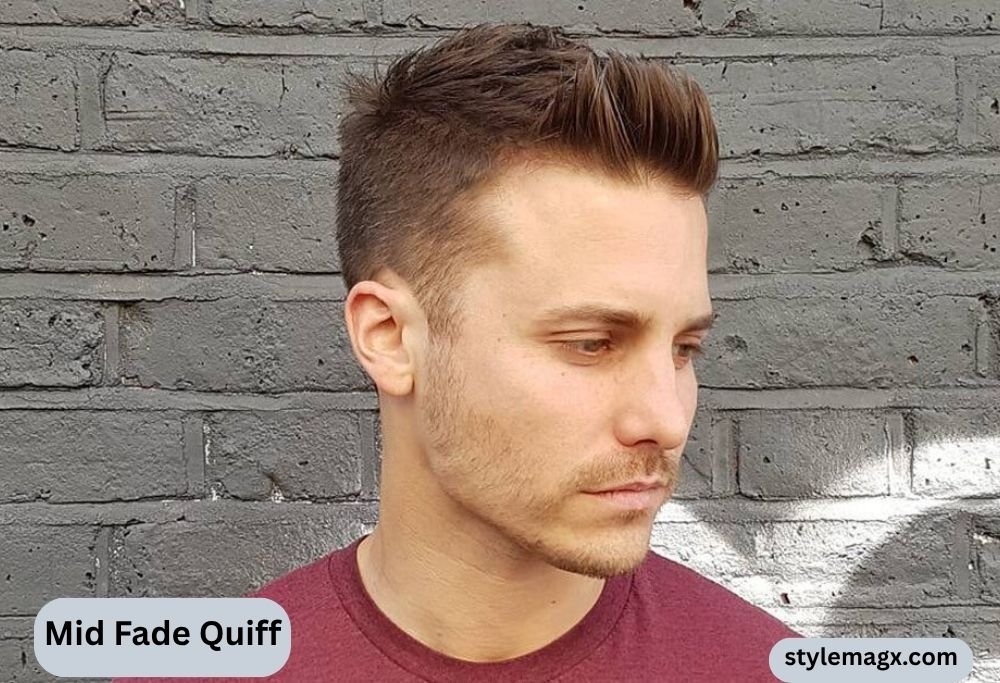
Similar to the pompadour, but pushed forward and up at the front rather than straight back. The mid fade quiff gives you separation between the top and sides, and it suits oval, square, and round face shapes particularly well. A little pomade or clay at the front keeps the shape holding through the day.
Mid Fade Side Part
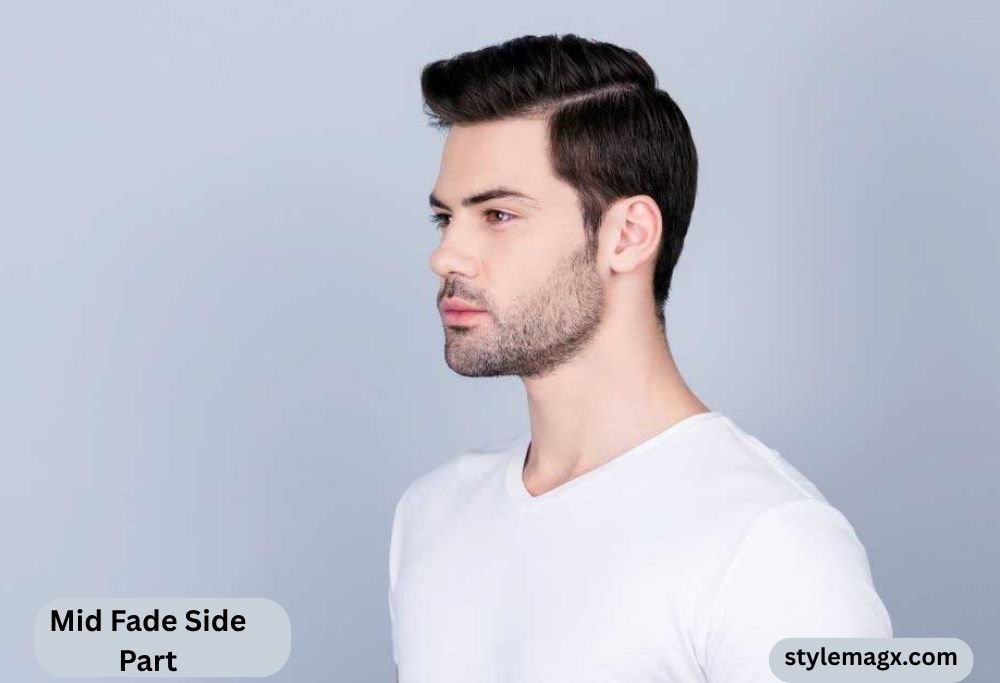
For a softer, more natural look, try a side part. Hair falls naturally to one side, with clean blended sides underneath. There’s no hard shaved line here, just a gentle split that follows your natural growth pattern. It reads as polished but not overly formal, which makes it versatile for work and weekends alike.
Mid Fade Comb Over
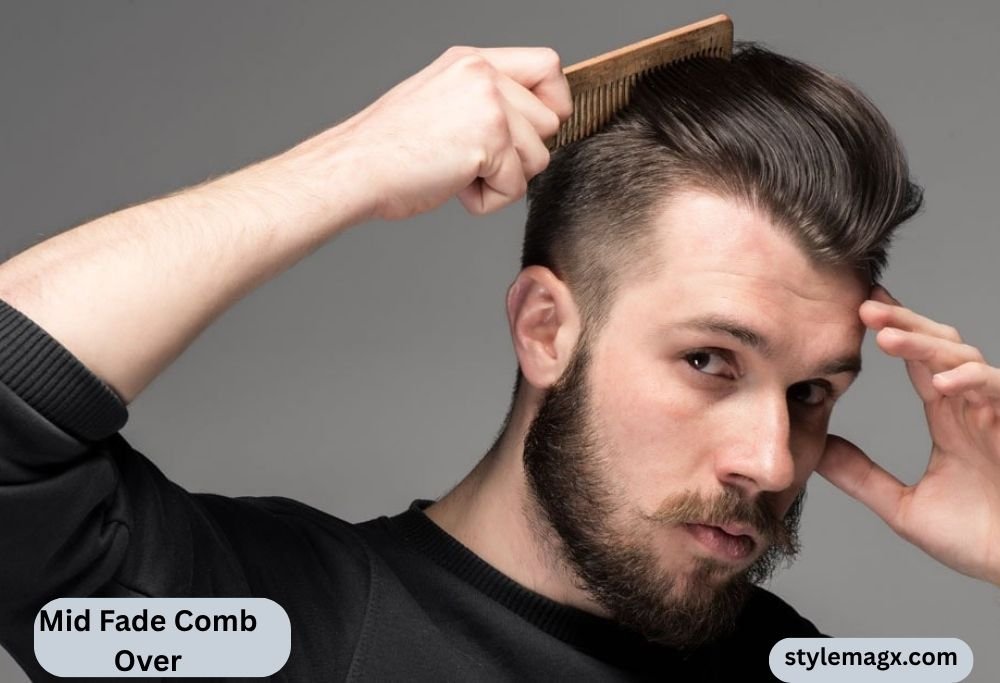
Take the side part and add a shaved hard part line, and you’ve got a comb over. It’s a touch more precise and structured than the standard side part, and the mid fade underneath gives it a sharper edge overall. This is a strong pick if you want something that looks deliberate and put together.
Mid Fade Slick Back
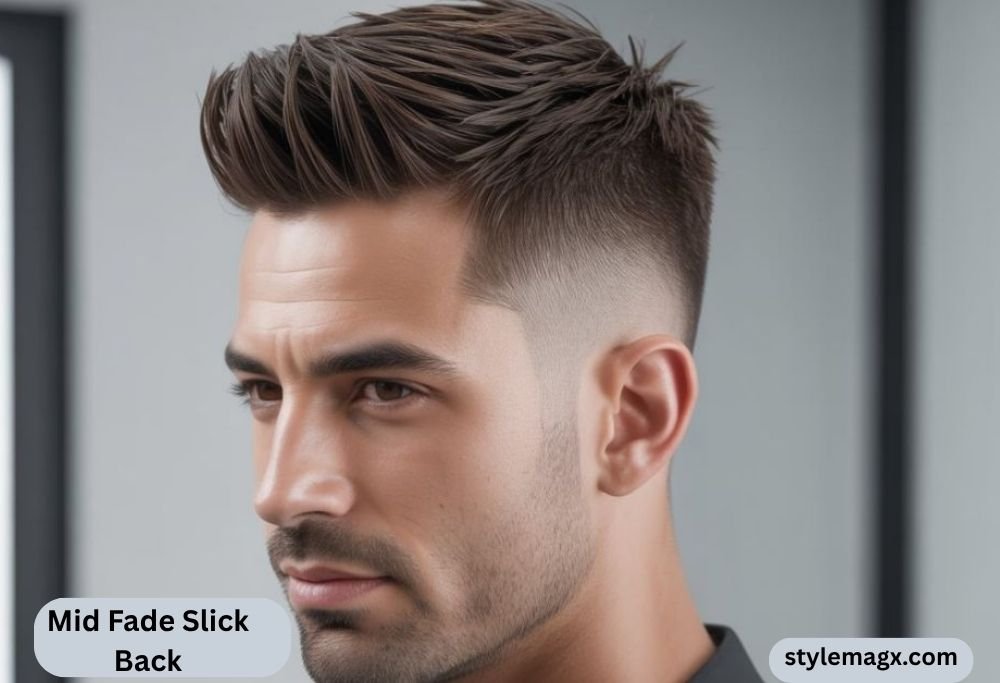
Hair combed straight back on top, mid fade tight on the sides. The smooth, combed top against faded sides creates a clean contrast that reads confident and put together. You can go for a high-shine finish with pomade or keep it matte with a lighter styling cream, depending on the occasion.
Mid Fade Hard Part
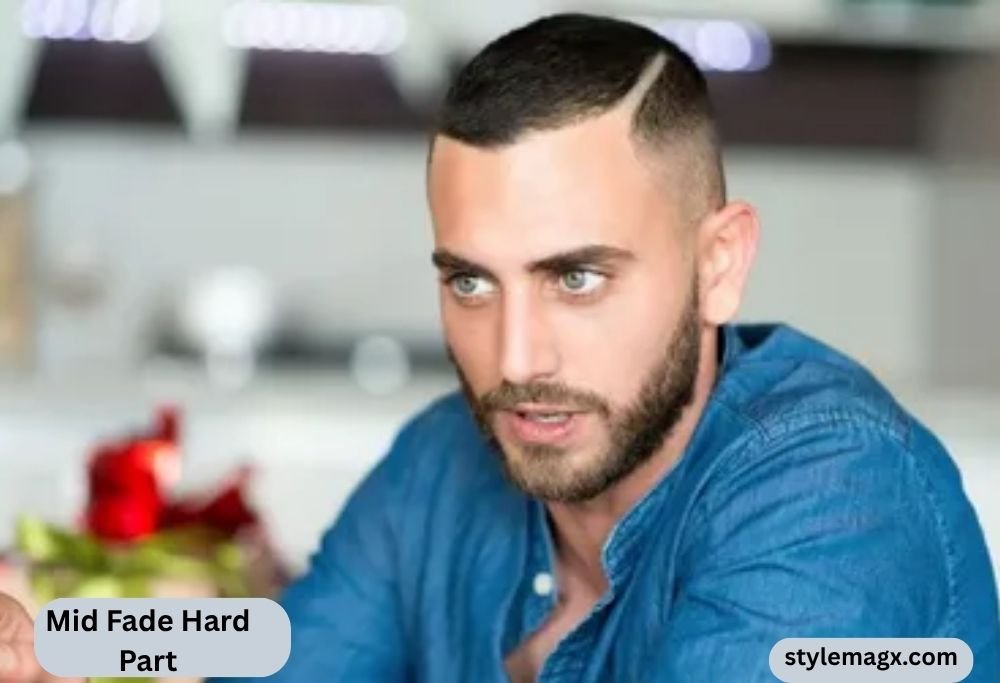
A mid fade hard part uses a razor-shaved line as a design feature, not just a parting. It sharpens whatever you’re doing on top, whether that’s a comb over or a textured crop. Just know that the line fades faster than the rest of the cut, so you’ll need more frequent touch-ups to keep it crisp.
Mid Fade Crew Cut
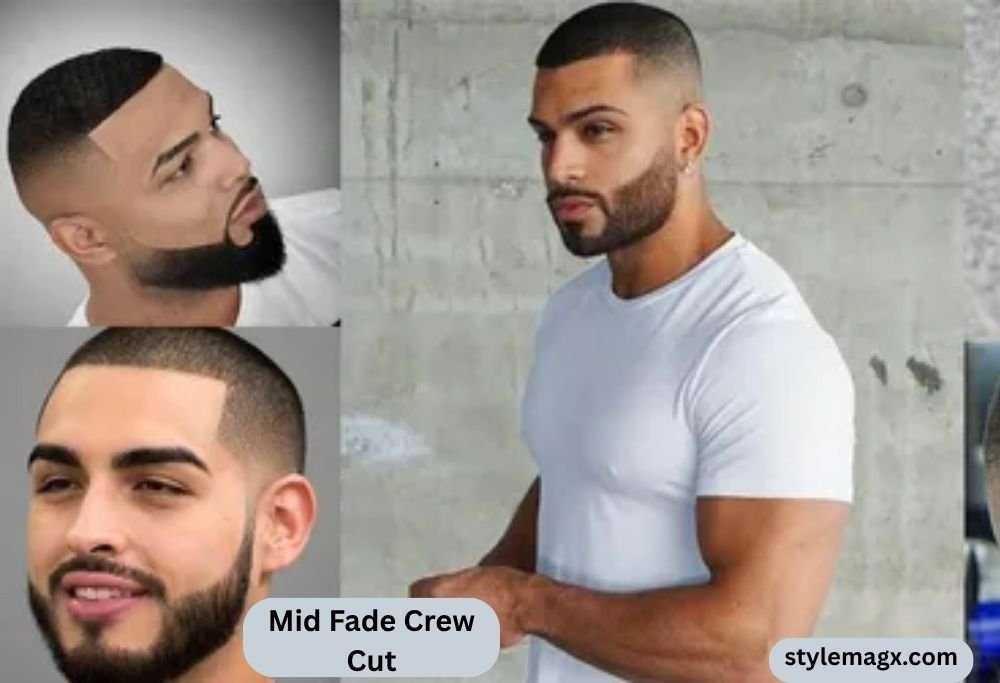
Short and even on top, slightly longer at the front, tapering back toward the crown, with a mid fade on the sides. This is about as close to zero-effort as haircuts get. It’s a favorite in office and professional settings because it always looks neat, even on days you’re rushing out the door.
Mid Fade French Crop
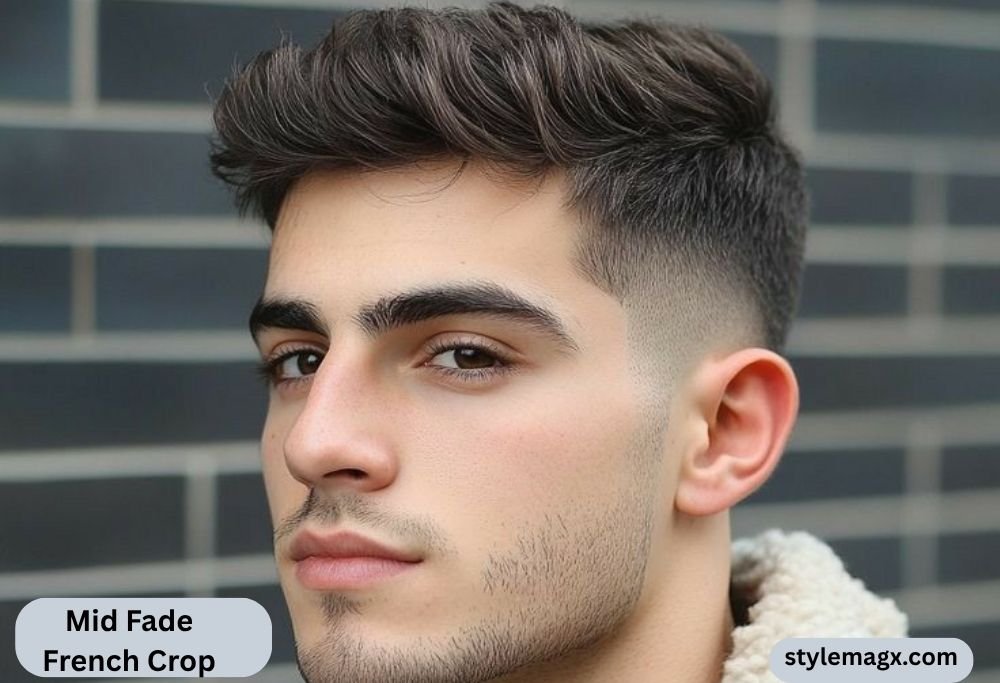
A blunt, straight fringe across the forehead paired with a short top and mid fade sides. The French crop reads more structured than a textured crop because that fringe line is cut straight rather than choppy. The added width up front suits round and square face shapes especially well.
Mid Fade Textured Crop
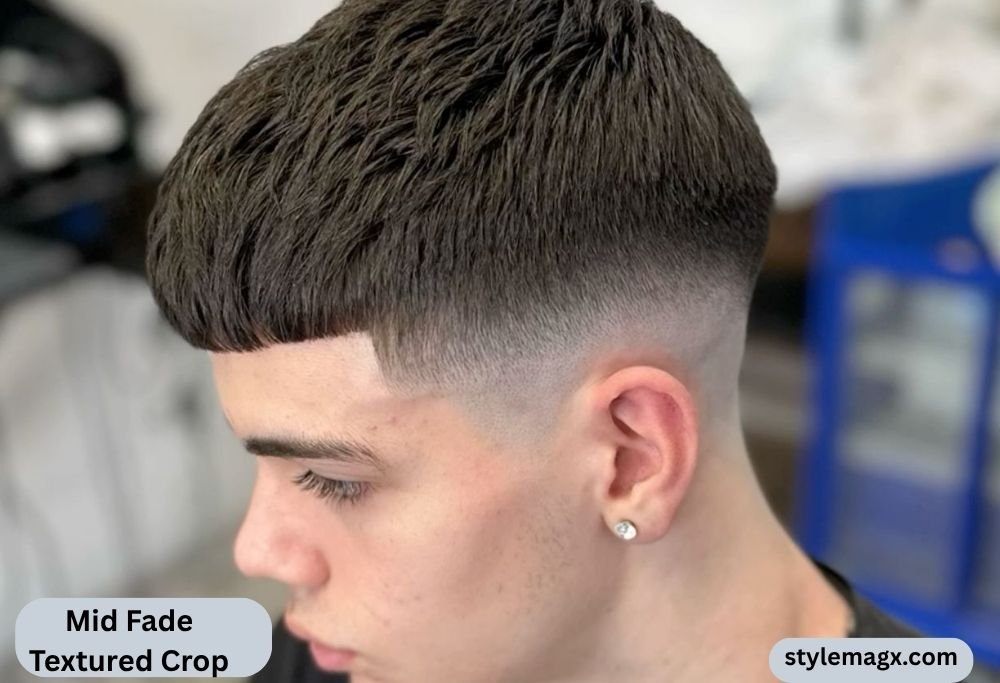
Choppy layers on top, fringe pushed slightly forward, mid fade sides underneath. This one works great on thick hair because the texture removes bulk on top while the tight sides keep everything balanced. It’s a go-to for guys who want a textured top with a bit of edge.
Mid Fade Faux Hawk
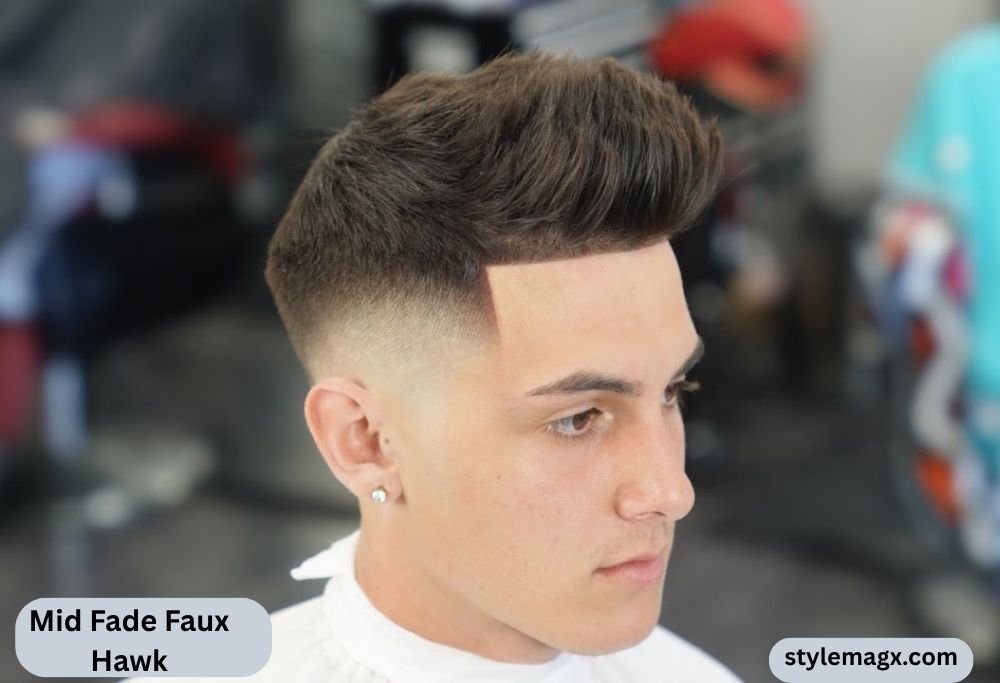
Hair styled upward through the center without fully shaving the sides, giving you that faux hawk shape. The mid fade adds enough contrast to make the center strip pop without committing to a full mohawk. It suits oval and square faces well, and it’s a nice middle ground for anyone wanting a bit of edge without going all in.
Mid Fade Mohawk
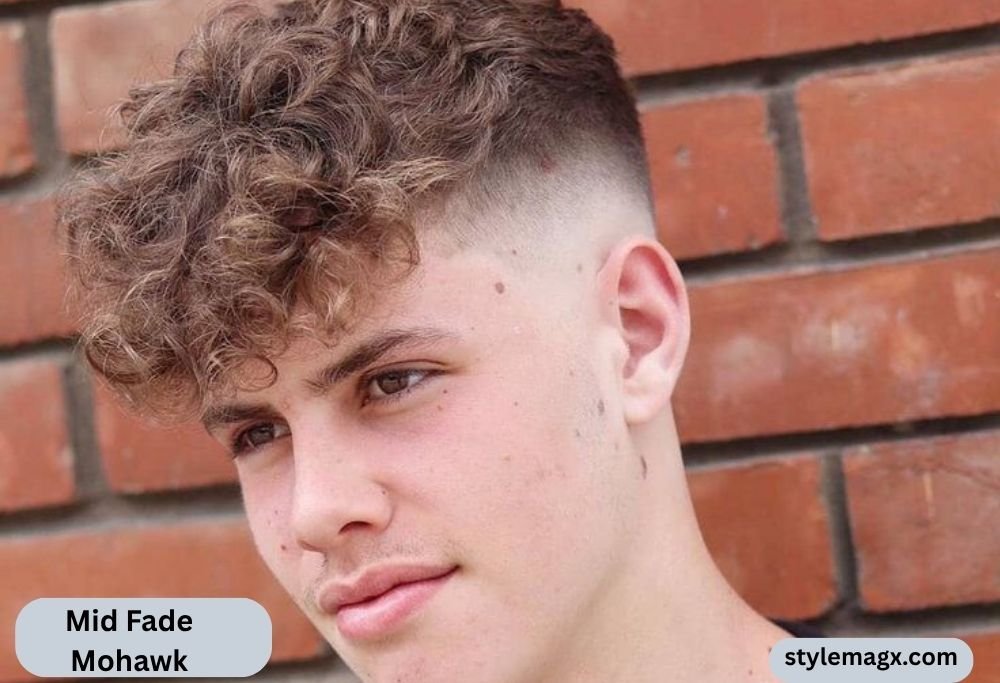
Speaking of committing fully, the mid fade mohawk leaves a strip of longer hair down the center with tight fades on both sides. The mid height creates tighter sides and makes that central strip stand out more than it would with a low fade. It’s bold, no question, but it’s also surprisingly wearable thanks to the fade underneath.
Mid Fade Modern Mullet
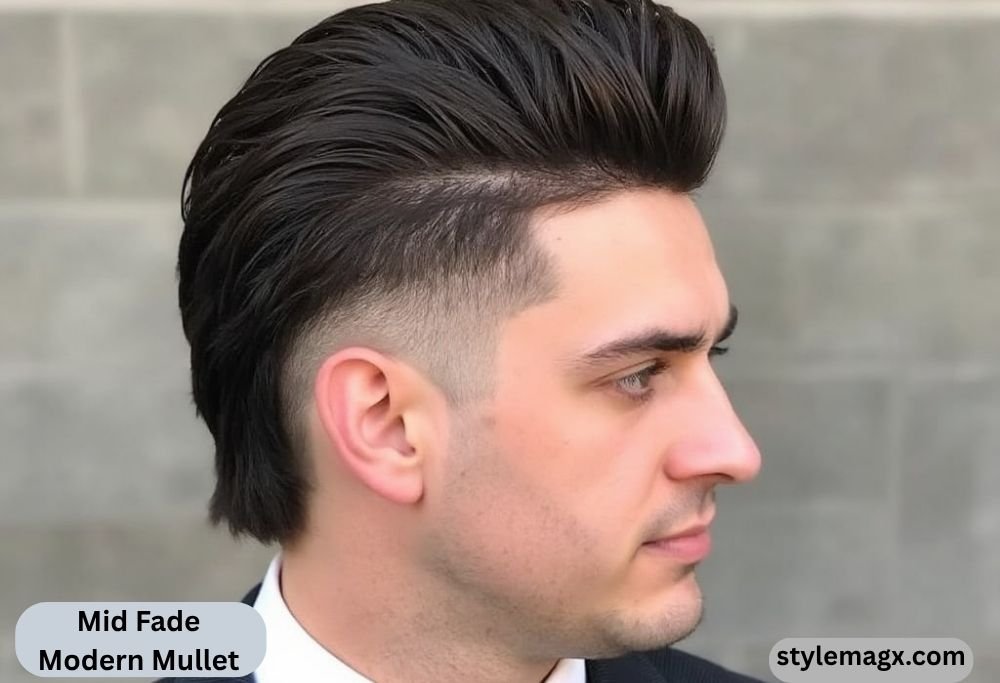
Short on top, longer at the back, mid fade on the sides. The modern mullet has made a real comeback, and pairing it with a fade keeps the sides looking structured while the length at the back stays intentional rather than just grown out. It’s a statement cut, best suited for guys who don’t mind turning heads.
Mid Fade with a Fringe
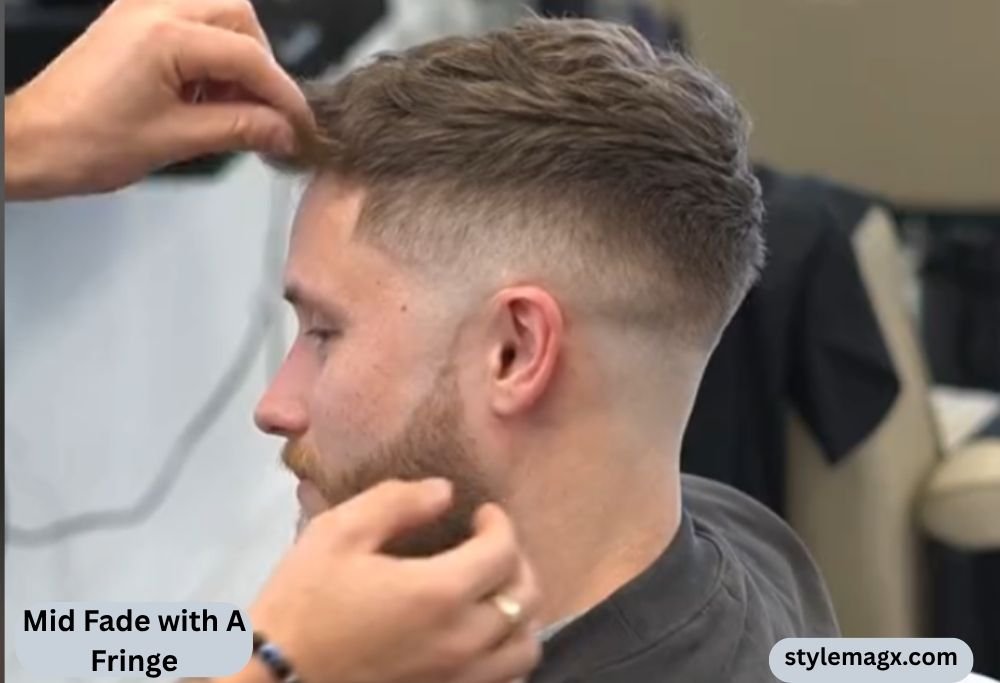
Let the hair fall forward naturally and sweep to one side, rather than combing it flat or pushing it up. This relaxed fringe style pairs nicely with tight sides, since the structure underneath keeps the soft, loose top from looking unintentional or messy.
Mid Fade for Curly Hair
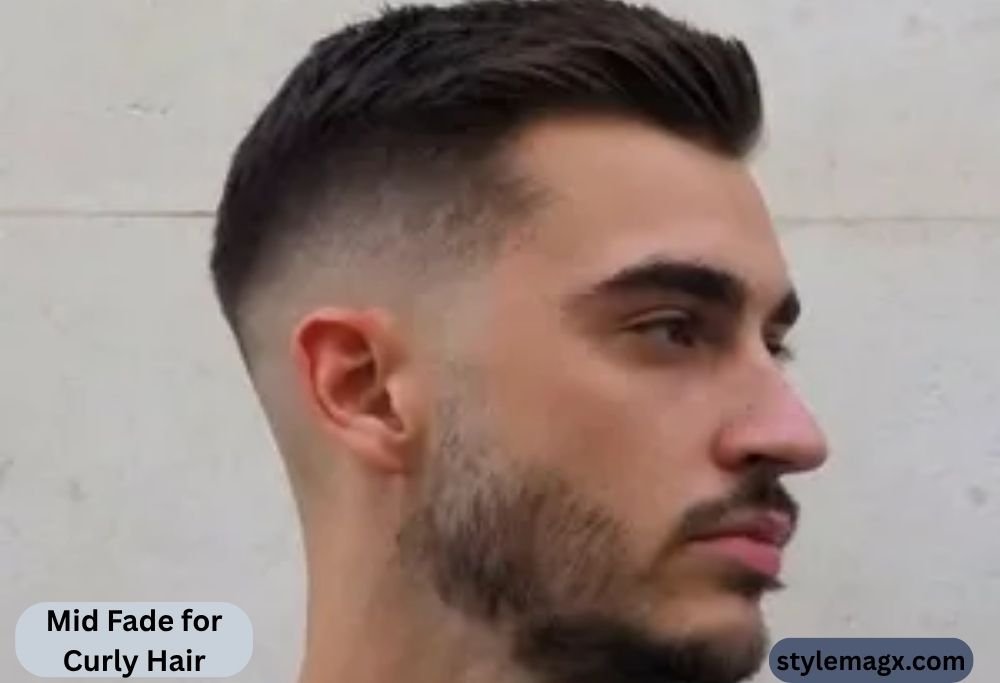
Every variation on this list can work with curly hair, but there’s a technique detail worth knowing. Curls shrink once they dry, so a fade that looks perfect at temple height when wet can end up sitting noticeably higher once your hair dries and contracts. Always tell your barber to judge the height based on your hair dry, not wet. Scissor-over-comb technique also gives more precision at the curl-to-fade transition than clippers alone.
Mid Fade for Wavy Hair
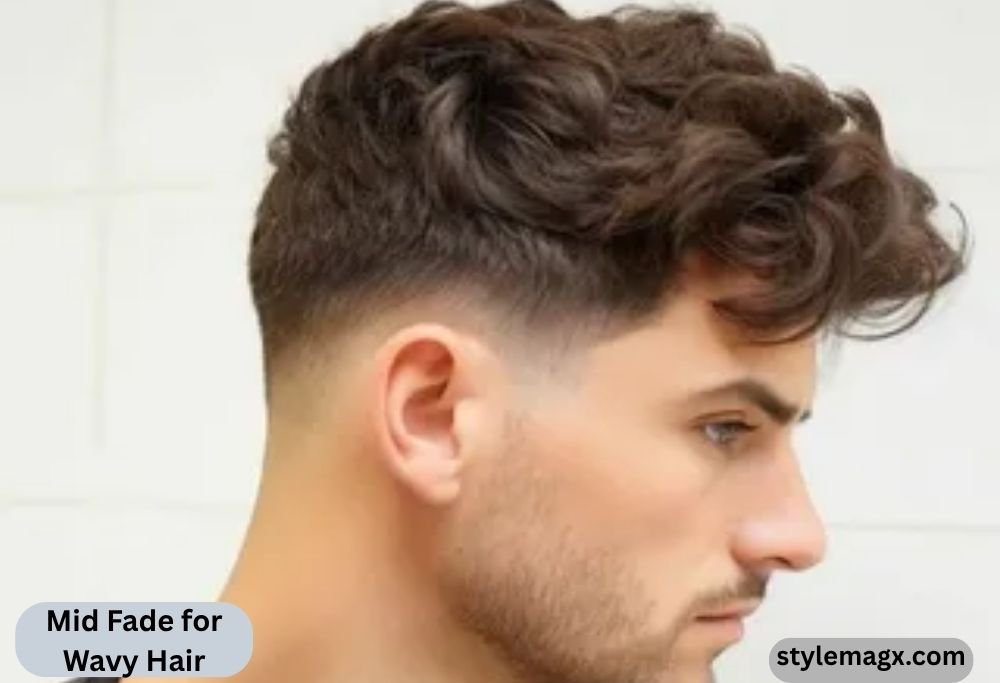
Wavy hair and a mid fade complement each other naturally. The waves bring movement on top, while the fade keeps the sides structured and clean. A drop fade in particular follows the natural wave direction instead of cutting against it, which makes the whole look feel more cohesive.
Mid Fade for Straight Hair
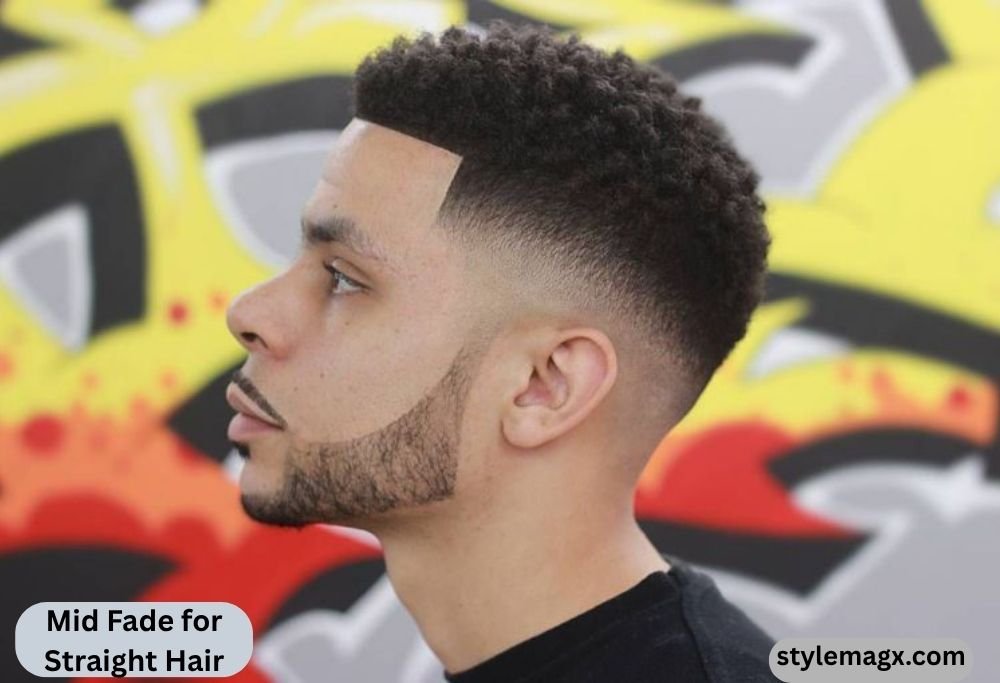
Straight hair gives you the sharpest possible fade lines because there’s no texture to soften the transition. The blend from short sides to flat hair on top looks precise and clean. Just know that grow-out shows faster on straight hair, so more frequent trims keep things looking sharp. Point cutting the top also helps avoid a flat, blunt finish.
Mid Fade for Afro-Textured Hair
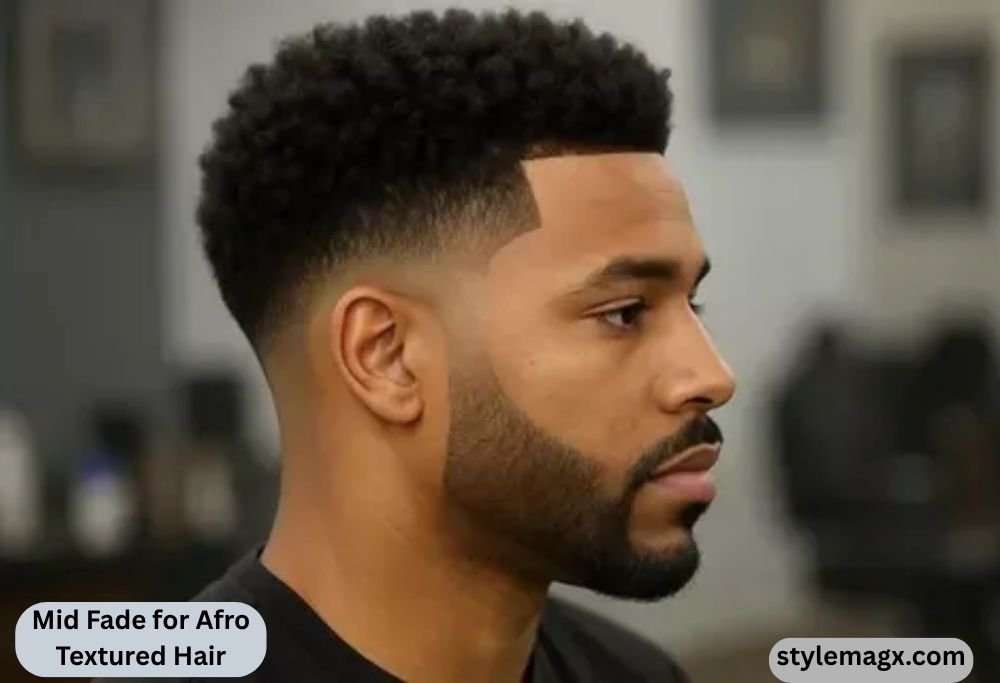
For Black men with tighter curl patterns, a mid temple fade or mid taper fade tends to work best. Cutting the hair dry, rather than wet, gives the barber a more accurate read on where curls will actually sit once they’ve settled. This detail makes a real difference in how clean the final result looks day to day.
Mid Fade with a Beard
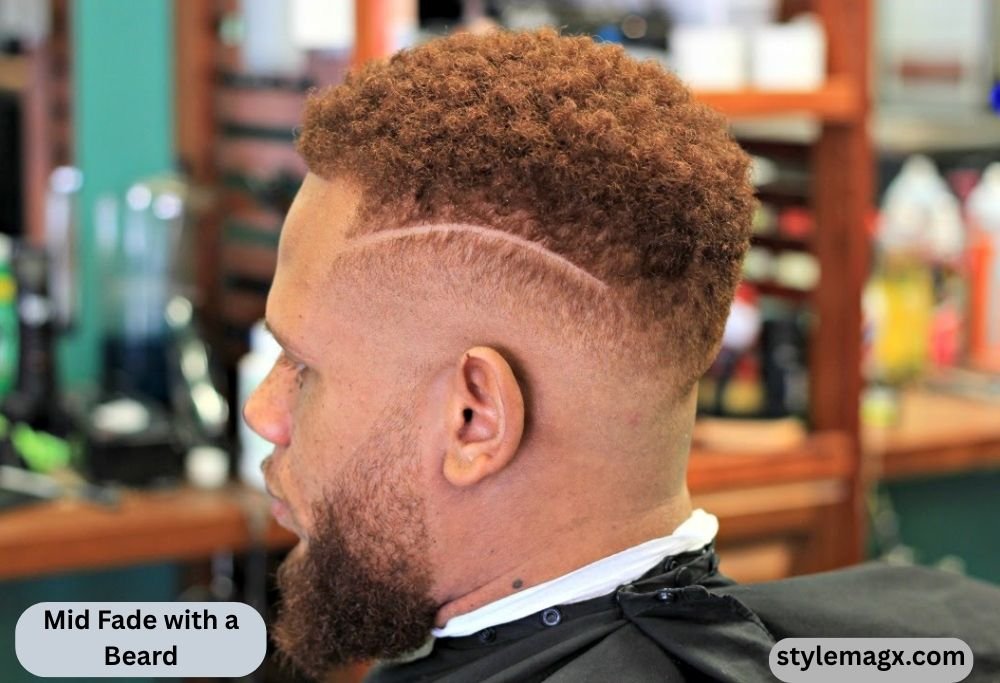
A mid fade haircut with beard needs one extra step most barbers won’t do automatically. Because a mid fade starts higher than a low fade, there’s more distance between the fade line and the beard. The barber needs to blend that gap carefully at the sideburn, rather than leaving a hard stop between the two. Ask for it specifically, and you’ll get a much more seamless finish.
Mid Fade with Long Hair on Top
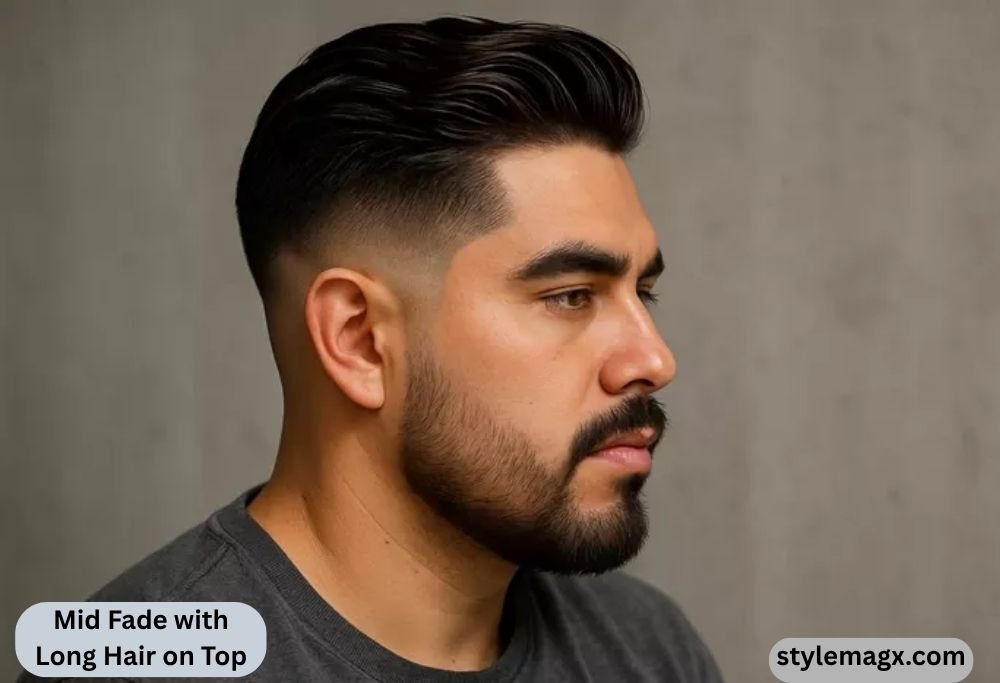
A mid fade haircut with long hair on top creates striking contrast between the tight sides and flowing length above. This works well for slicked back looks, brush backs, or even loose, textured styles. The extra length gives you more styling options day to day, though it does mean a bit more product and time in front of the mirror.
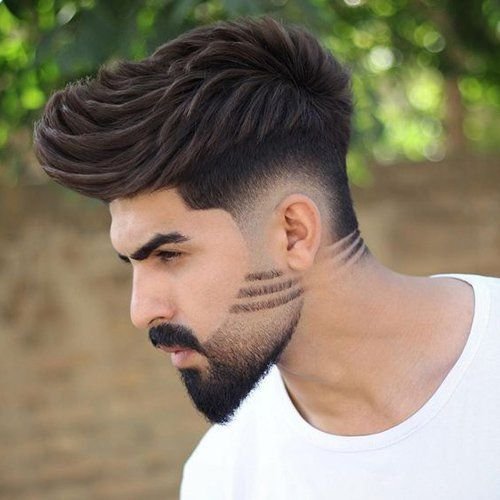
Mid Fade with a Hair Design
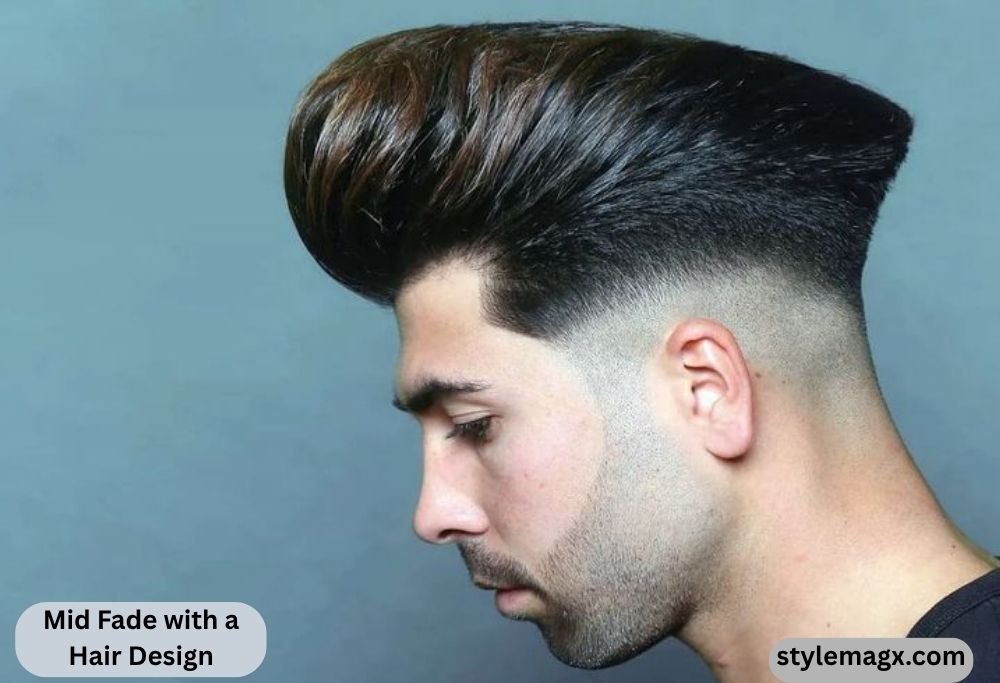
Some men take the fade a step further with a shaved pattern or line worked into the design. It’s a personal, creative touch that turns a standard fade into something unique. This works especially well with shorter top styles, where the design has room to stand out clearly.
Mid Fade Blowout
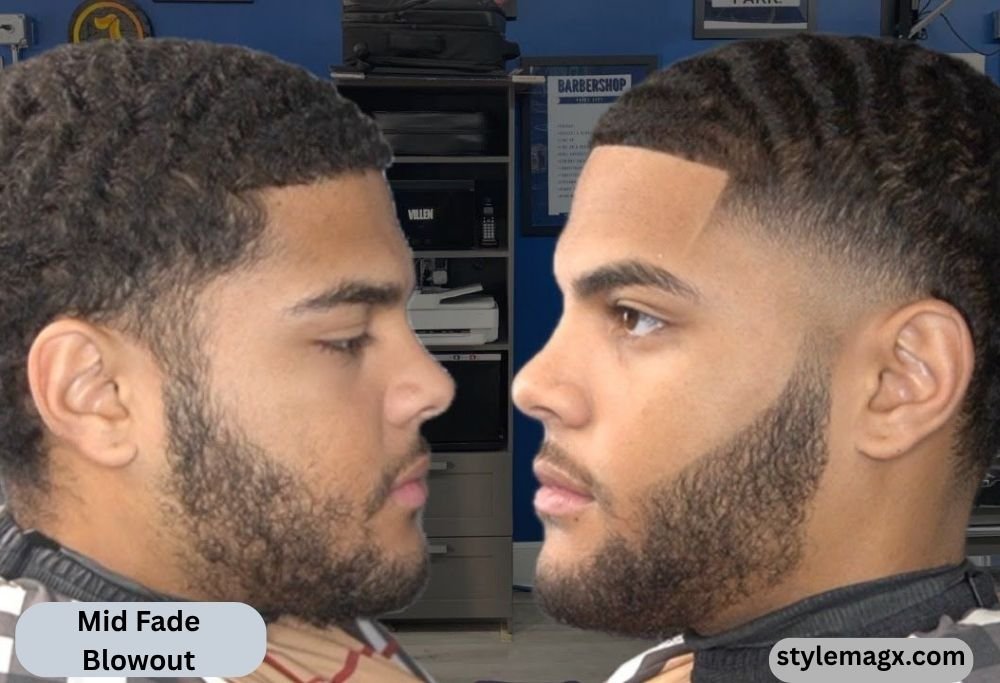
The mid fade blowout blow-dries the top up and back for serious volume and texture, while the sides stay tight underneath. It’s bold, textured, and a favorite in barbershops that specialize in hair styling for thicker hair types. This one takes a bit more effort at home, but the payoff is a fuller, more dramatic look.
Who Should Get a Mid Fade? Best Face Shapes and Hair Types
Good news here. The mid fade genuinely works for haircut for different face shapes, which is rare for a single style. What changes isn’t whether you can wear it, but which variation flatters your features most. A round face benefits from added height on top, while a square jaw might want to avoid over-sharpening with a very tight skin fade.
Hair type matters just as much as face shape. Mid fade haircut for thick hair usually means you can go closer to the skin without it looking sparse, while fine or thin hair often looks better with a taper that never quite reaches bare skin. Matching the technique to your actual hair keeps the cut looking intentional rather than accidental.
Best Face Shapes for a Mid Fade
| Face Shape | Best Variation | What to Avoid |
| Oval | Nearly any variation works | Nothing in particular |
| Round | Mid skin fade with volume on top | Flat styles that add width |
| Square | Classic mid fade or mid taper | Over-sharpening near the jawline |
| Oblong | Mid taper fade | Too much height on top |
| Diamond | Mid drop fade | Very tight skin fade at the sides |
| Rectangular | Pompadour or slick back | Styles that add extra width |
| Heart | Side part or comb over | Very tight fade at the temples |
Best Hair Types for a Mid Fade
| Hair Type | Best Variation | Key Tip |
| Straight | Any variation | Point cut the top to avoid a flat look |
| Wavy | Mid drop fade | Leave length on top for natural movement |
| Curly | Mid drop or mid burst fade | Judge the height based on dry hair |
| Coily / 4C | Mid temple or mid taper fade | Ask your barber to cut it dry |
| Thick | Mid skin fade | High contrast reads clean on dense hair |
| Fine or thin | Mid taper fade | Skin at temple height can overexpose the scalp |
Mid Fade vs Other Fades: Key Differences
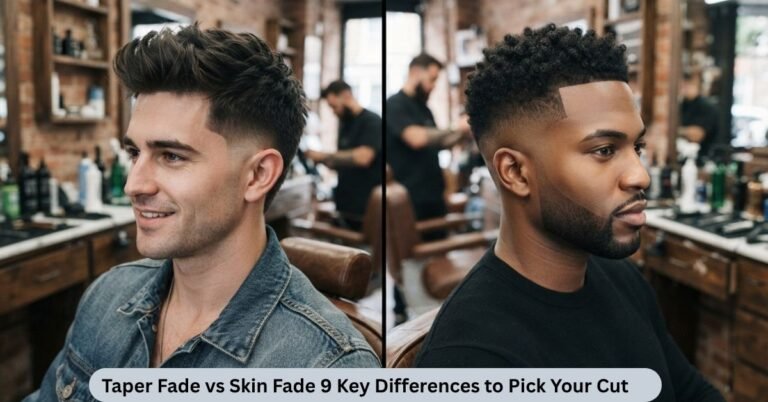
Confused about mid fade vs low fade or where a skin fade fits into all this? You’re not alone. Fade terminology gets tossed around loosely, and it helps to break down exactly what separates each style. The short version: height determines whether it’s a low, mid, or high fade, while closeness at the base determines whether it’s a taper, skin, or bald fade.
Understanding these differences means you’ll never leave the barber chair with the wrong result again. It also helps you communicate more clearly, which matters more than most guys realize until they’ve had a haircut go sideways from a vague request.
Mid Fade vs Low Fade
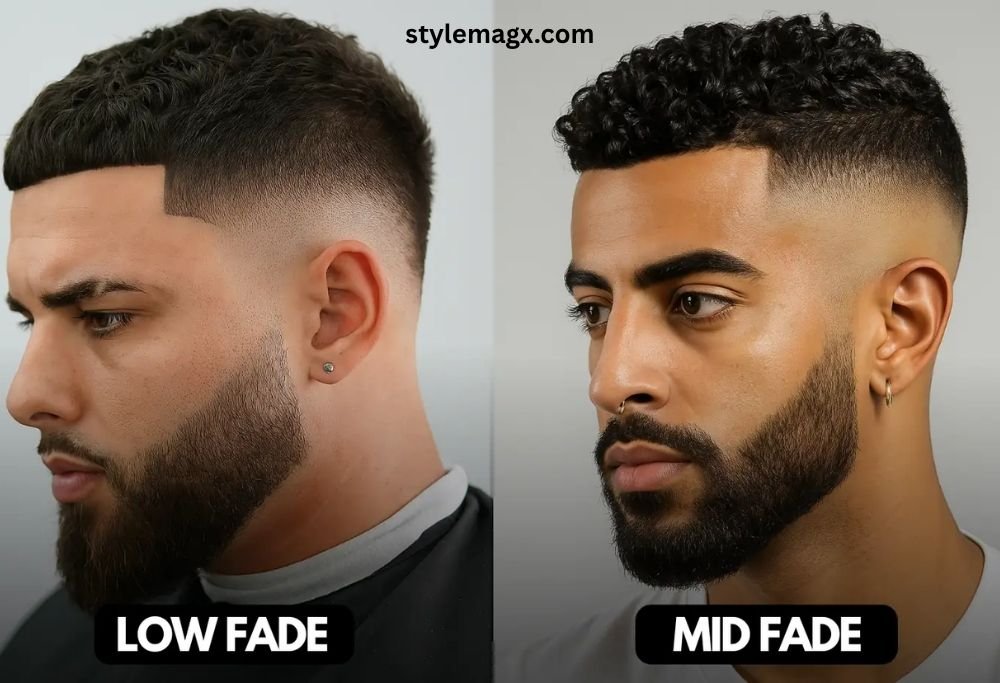
A low fade starts just above the ear, keeping most of the contrast subtle and close to the hairline. A mid fade starts noticeably higher, at the temple, which means more visible contrast right from day one. If you’re used to a low fade, switching to mid can feel like a bigger change than expected at first.
Mid Fade vs High Fade
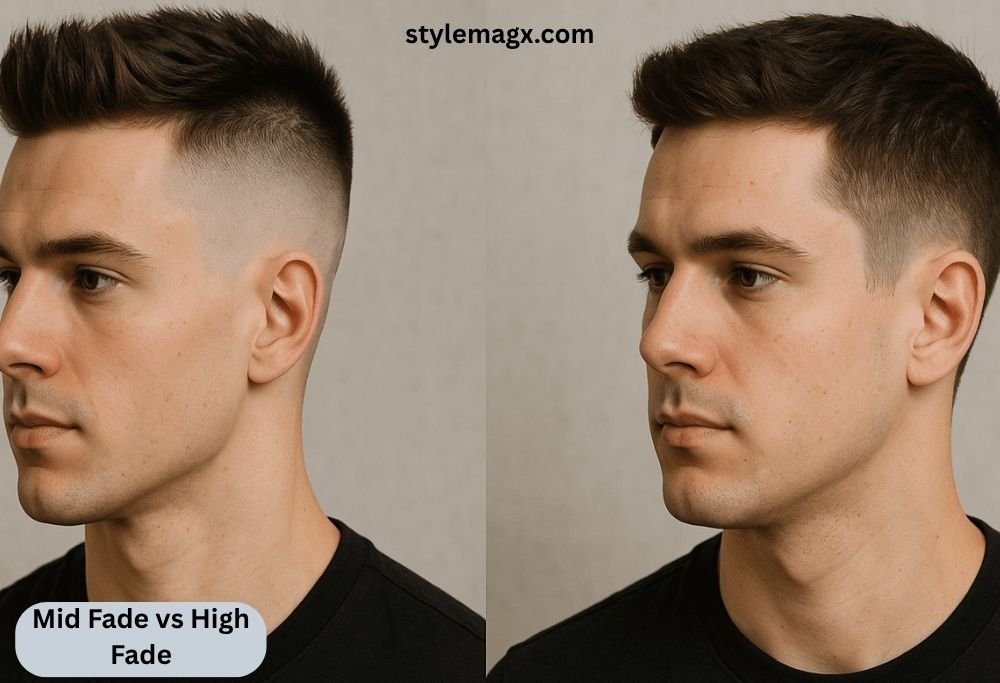
A high fade pushes the starting point even further up, sometimes close to the crown, creating the boldest contrast of the three. The mid fade sits comfortably in between, giving you noticeable definition without the drama of a high fade. It’s generally more office-friendly too, since it reads as sharp rather than edgy.
Mid Fade vs Skin Fade
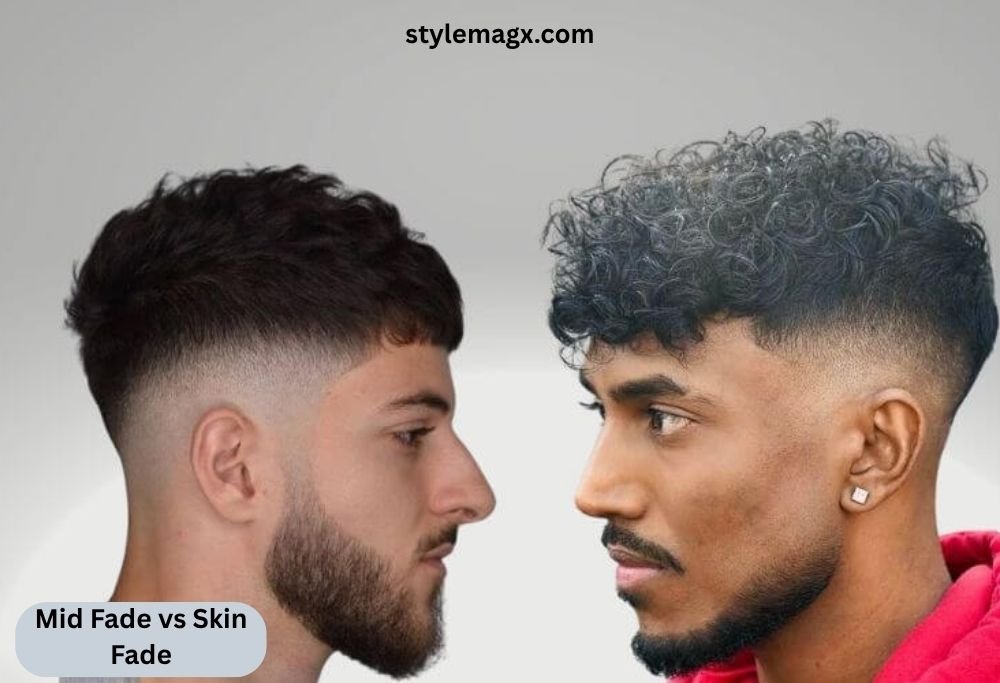
This comparison confuses a lot of people because they’re actually describing two different things. “Mid” refers to height, while “skin” refers to closeness. So you can absolutely have a mid skin fade, where the fade starts at the temple and finishes down to bare skin at the base. They’re not competing styles. They work together.
How to Ask Your Barber for a Mid Fade
Walking in and just saying “mid fade” leaves three important decisions unmade, and a good barber will ask you to clarify anyway. Save time by covering all three yourself. First, confirm the height by saying “starting at the temple,” which locks in mid rather than low or high. Second, specify closeness with either “skin at the base” or “keep some hair at the base” depending on how bold you want it. Third, mention the shape, whether you want it straight all the way around or dropped behind the ear for extra detail.
A solid all-in-one phrase looks like this: “Mid fade, starting at the temple, skin at the base, straight line all the way around.” If you’ve got curly hair, add this line too: “Set the height based on how my hair looks dry, not wet.” And for anyone pairing the cut with facial hair, don’t forget to say: “Blend the fade down into my beard at the sideburn, no hard gap.” These small details separate a decent cut from a genuinely great one.
Best Products for Styling a Mid Fade
The right product depends entirely on what you’re doing with the top, not the fade itself. A textured crop needs something different from a slicked-back look, and knowing the difference saves you money and bathroom counter clutter. Below are six solid options worth having in rotation depending on your top style and hair type.
| Product | Best For | Finish |
| Sea Salt Spray | Wavy or straight hair, beachy texture | Matte, tousled |
| Volumizing Mousse | Fine or thin hair needing lift | Light, airy |
| Texture Clay | Textured crops, quiffs | Matte, strong hold |
| Molding Paste | Slick backs, comb overs | Natural shine, strong hold |
| Texture Powder | Root lift, subtle volume | Matte, lightweight |
| Styling Cream | Everyday, natural looks | Light hold, soft finish |
How Often Should You Get a Mid Fade Touched Up?
Fade maintenance varies quite a bit depending on which variation you chose. A mid skin fade needs the most frequent attention, typically every one to two weeks, since bare skin grows out visibly fast. Buzz cuts, mohawks, and hard parts sit in the two-week range too. Most other top styles, including the classic, drop, and burst fade, hold up well for two to three weeks between visits. The mid taper fade stretches the longest, often lasting a full three weeks since there’s no hard skin line to maintain.
Between barbershop visits, trimming your own neckline at home helps keep things tidy without a full appointment. Because a mid fade sits higher than a low fade, growth tends to show on the sides faster than you might expect, so don’t be surprised if you’re back in the chair sooner than you planned the first few times.
FAQ’s
What is a mid fade haircut?
A fade that starts at temple level and blends shorter down toward the neckline. It sits between the subtler low fade and the bolder high fade, and it’s also called a medium fade.
Is a mid fade the same as a medium fade?
Yes. Same haircut, different name. Most barbers understand both terms interchangeably, so you can use whichever feels more natural to say.
How long does a mid fade haircut last?
It depends on the variation. A mid taper fade holds for about three weeks, classic and drop styles run two to three weeks, and a mid skin fade needs touch-ups every one to two weeks.
What clipper guard is used for a mid fade?
A number one or two guard at the base works for a classic mid fade. For a skin fade finish, barbers use a zero guard with a straight razor, working upward with progressively longer guards to build the blend.
Can I get a mid fade with curly hair?
Absolutely. Just tell your barber to judge the fade height based on how your hair looks dry, since curls shrink and can push the line higher than you intended once they settle.
Is mid-fade haram in Islam?
Views differ among scholars. Some permit fades if they don’t imitate disbelievers or specific forbidden styles (like shaving only part of the head, known as Qaza), while others advise caution, so it’s best to ask a trusted local scholar.
What’s better, mid-fade or taper?
A mid-fade gives sharper contrast and a bolder look, while a taper offers a softer, more gradual blend with easier grow-out. It comes down to how much contrast you want.
What is the best mid-fade haircut?
The classic mid-fade is the most versatile pick, working with nearly any face shape and hair type. For more edge, a mid drop fade or mid burst fade are strong runners-up.
Which fade is better, low or mid?
A low fade looks subtler and blends closer to the hairline, while a mid-fade adds more visible contrast starting at the temple. Neither is “better,” it depends on how bold you want the look.
Conclusion
The biggest mistake men make switching to this cut is underestimating just how much higher it sits compared to a low fade. That extra height creates noticeably more contrast, and it can catch you off guard during the first week if you’re used to something subtler. If you want to ease into it, ask for a mid taper fade first. Same starting height, no skin at the base, and a gentler transition overall.
Other common slip-ups include not specifying dry versus wet hair length for curly and coily textures, which can leave the fade sitting too high once curls settle. Skipping the beard blend request is another one, often resulting in an awkward hard gap at the sideburn. And choosing the wrong guard for your hair density, going too close on thin hair or not close enough on thick hair, tends to leave the final result looking off no matter how skilled the barber is.
Ryan Carter is a men’s hairstyle and grooming writer who shares the latest haircut trends, styling ideas, and practical tips to help men find a look that suits their style and personality.